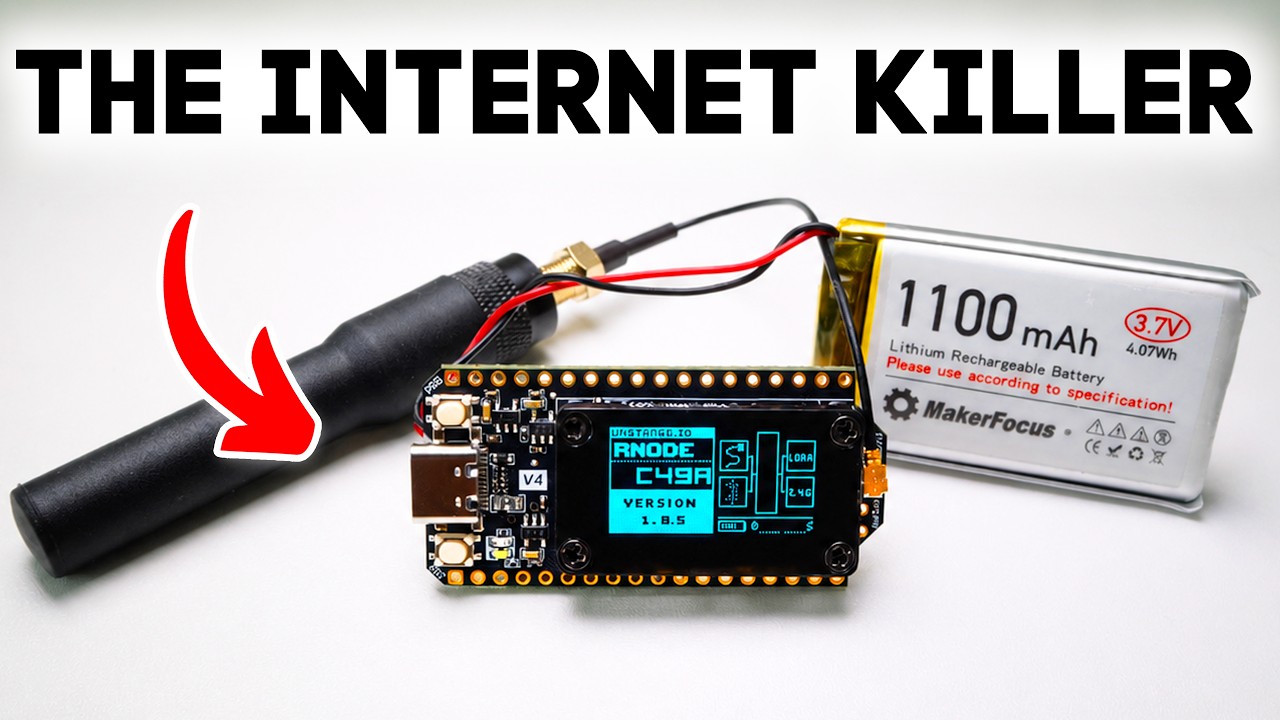
No internet required… In this video, I build a public Reticulum node and test whether it can bridge completely different networks into one encrypted communication path. I send messages from a normal phone over LTE, through the internet and Starlink, then off-grid over LoRa—eventually using a $20 drone-mounted relay to reach a phone with no internet connection at all.
Except the LTE, Internet and Starlink would be your ISP. It’s whatever facilitates an IP(v6) address to connect to the web.
Huh. I actually didn’t know that this supports up to 1gbps. I thought it was just low bandwidth.
It is as soon as you use LoRa. Reticulum is just an overlay
This title is so bad it gave me cancer
I believe this stuff is going to be huge. Reticulum, Lora, Meshtastic all bit players now in a drama that has yet to get a finished script. It will start out as a supplement to the Internet, allowing you connectivity even when your Internet falters and as it becomes more ubiquitous, it will be increasingly used/usable and increasingly important. It can’t be shut down, it can’t be controlled. A country would literally have to ban radio signals of any kind in order to shut it down. It’s free. Buy the hardware, use the network, because you are the network. I love this.
LoRa is very low bandwidth, only suitable for short text messages. Radio frequencies are heavily regulated, easy to triangulate, and can be shutdown. People could build a higher speed, planned WiFi mesh; hops just have to be closer. Neighborhoods could build cat6 and fiber into meshes if they wanted to as well.
hops just have to be closer.
It doesn’t take much of a leap of imagination to see a torrent-like system utilizing all available devices within earshot to spread the bandwidth around to realize a pretty fast system available nearly everywhere in dense urban areas and slower (but ubiquitous) coverage the more rural you get. Obviously we’re far away from that now, but this definitely seems like the future to me.
“Internet killer”
I send messages from a normal phone over LTE, through the internet… to reach a phone with no internet connection at all
Sure. But the point is with Reticulum you dont NEED to leverage existing internet infrastructure. This guy chose to for his demo, but you could easily do the same thing over RS485, or a serial port, or ametuer radio bands. The protocol is medium agnostic.
No, its no internet killer. But its useful right now and pretty fun to mess around with.
I think it’s illegal to use Reticulum over amatuer radio because it’s encrypted?
You’re correct. But the protocol supports it.
Biggest bullshit ever written in the history of mankind.
What has the constitution got to do with any of this? Winky face.
Reticulum is a great project, but it’s not a replacement for the internet. LoRA (a potential piece in that chain) has very low data throughput; it’s fine for messages, but you’re not delivering web pages or streaming media with it.
Unless and until the throughput can be increased, Meshtastic/Meshcore is really only a replacement for text messaging, which might be perfectly fine for setting up encrypted comms or rapidly deploying communications in an emergency scenario.
Exactly the problem: bandwidth and latency.
The radio frequencies these run at and the power they’re allowed to use limits them to very very low bandwidth for data transfer. They can’t even do a low bitrate audio stream.
What they can do is messaging without 3rd party oversight and with adhoc data links. They’re very very cool for offline networks, especially in places without extant infrastructure for transmissions.
That was the thing that made me think reticulum was worth pursuing actually. It does work over a lot of stuff besides lora. You can mesh WiFi routers or other protocols. The issue is bandwidth ota since so much is dedicated to commercial stuff, but you can route reticulum over that including through i2p for anonymity. Meshtastic very much focuses on lora only, reticulum does not.
Yep, I agree with all of that. The original source here is specifically using LoRA, which is why I focused upon it, but Reticulum is certainly more than that.
Both are terrible for that. I hope that it’s a small number of people that get killed relying on LoRa for emergency communications that result in the project(s) being sued out of existence.
Hey guys, I’ve got a great idea: Let’s buy some $15 Arduino-like devices with milliwatts of transmitter power and trust them to life and limb! Even stupider than the people who buy Baofeng radios to put in a “bug out bag” and never use. Those at least mostly work.
I’m actually interested in your reasoning why you feel that way. Care to expand on that?
By “both are terrible for that” I mean both Meshtastic and Meshcore are terrible for emergency comms.
My relevant experience: I’m a General class ham, have been for over a decade now, I’ve used my radio equipment for such things as manning way stations on ultramarathons. These utterly insane strips of sentient beef jerky will go for a casual 40 mile jog through the Uwharries. We kept track of the runners as they ran through the stations so no one got lost for too long, went searching when someone turned up missing, and occasionally called for an ambulance for injuries. The guy who slipped on a rock and hit his head was probably the most important radio call I’ve ever made.
20 watts of VHF punches through the forest no problem. I could reach both stations on either side of me direct, 5 and 3 miles away, I could hear everyone involved on a repeater we designated including folks at the fire department in Troy. It’s also not that hard to use, you push the button and talk.
LoRa uses a couple techniques to stretch the power it has, low power and that chirp modulation thing it does that I don’t fully understand to make it easier to pick out of the noise floor, but you’re still talking a tenth of a watt and a frequency that is strongly absorbed by vegetation. If you live in a forest, LoRa is useless. Even if you do set up Meshcore repeaters high on structures, which a couple of my buddies have done, repeater to repeater you get 30 miles of range, and about half a mile range to companion nodes on the ground. line of sight is VERY particular, I’ve had two identical nodes sitting on top of my car, one could hear a repeater the other couldn’t.
Couple that with most LoRa nodes like that, used for something like Meshcore or Meshtastic, are basically little external modems. The companion node itself isn’t really usable on its own, you need to pair it over bluetooth to a smart phone running the Meshcore app. And then you get the world’s half bakedest text messaging system. In most service, it’s like radio, but text. If your radio didn’t hear a message when it was transmitted because it was in the car or you were standing near a tree or the antenna was touching you…too bad.
I really want to be the ultramarathon jogger who trips on a root and hits his head in the woods at an event where the safety officer’s radio can be 3 feet too far to the left to send or receive any messages.
It might be a fun little toy in a city where you have a dense population and buildings you can put nodes way up high on, maybe it works in the desert where trees are illegal, but I live in a forest. I can shout farther than LoRa.
I haven’t messed with Reticulum. It is my understanding that Reticulum works over several media including but not limited to LoRa so it probably shows more potential.
Oh, a final note about Meshcore: It’s a FOSS project, so the low level packet protocol is very thoroughly documented but there are basically no user instructions.
You want to try training your normie family to use Meshcore? Keep a little walkie talkie they don’t directly interact with in their pocket with their phone, keep both charged, etc? Sure.
I think we may be talking about different things. When I originally said “emergency comms,” another way to say that would be “ad hoc communications in a disaster scenario.” I was imagining coordinating teams and disseminating information in a scenario where typical radio stations might be damaged or otherwise unavailable.
It seems that when you say “emergency,” you’re imagining a person who needs immediate medical intervention. For that purpose, I agree that I wouldn’t rely upon LoRA technology unless it was literally the only viable option.
My local ham club treats that ultramarathon as an emergency preparedness drill. It requires us to bring radio equipment out into the woods away from power outlets and cell phone coverage and spend a day communicating by VHF FM over rugged wooded terrain. It’s a pretty solid simulation of setting up an ad hoc communications system during a disaster scenario such as a hurricane, no? We’re there so that we can figure out when a runner has gone missing, approximately where on the trail, find them, and maybe call for help if they’re hurt. That’s not dissimilar to our mission when we man the emergency shelters for the purposes of “do you have enough diapers” or “is this missing person at your shelter?”
“Ad hoc disaster communications” can mean anything from keeping in touch with your party if you have to split up to getting news from the outside world to calling for help from the outside world. Frankly I think any of those LoRa networks are next to useless for that. The hardware is kind of pathetic, from my hands-on experience, and in a wooded area it’s almost designed to not work.
For getting news from the outside world, an AM radio receiver as installed in every car can hear for a few hundred miles during the day and a thousand miles at night. Commercial broadcast FM radio has a range of 50 miles or so assuming a receiving antenna at about chest height. I might recommend having and knowing how to use a television antenna. Powering a modern television from a generator and receiving over the air broadcasts might just get you a news conference with the governor or something.
This part is US centric: NOAA operates a network of radio transmitters in the 160MHz range broadcasting weather updates. If you don’t own one of those receivers, get one. They’re cheap, easy and useful.
Communicating with your own group, a family or neighbors or whatever your situation is, GMRS or MURS is a better solution. Both allow 20+ times the power than LoRa. MURS is VHF, just above the 2 meter ham band, it punches through foliage a lot better but is limited to simplex only. GMRS is UHF, just below the amateur 70cm band, not as easy to push through the trees but repeaters are allowed. Depending on your situation and what other folks in your area are doing, those are likely better choices.
Reaching out for help…the problem with something like LoRa for this is you’re relying on a bunch of very cheap, shoddy little radios to relay a message to…someone. CB might be a choice here, it’s a standard in the trucking industry and you might get some propagation, but being or knowing a ham is probably your best bet. Emergency comms is one of the stated purposes for creating the amateur radio service, that’s what the ARES service is for, if you’re really interested in emergency comms you should probably look into it.
Running a reticulum node myself. Great project!
Definitely an interesting video to watch and I like what he’s doing.
I did find that his script seemed to be fairly repetitive for a number of points he was making, but I’m still subscribing since, overall, it was a good informative video. Thanks for sharing!
Had a play with meshtastic, but no other nodes in my city.
Meshcore seems to be the more popular choice: https://meshcore.io/map
Where are you living? Make sure you read local forums, they might have specific connection settings to hide. Anyway meshtastic is slow and cannot even transmit voice. This could be better if there will be nodes.
There’s a guy that lives maybe 2 miles from me. Could see nodes all around him, and many even further away, but could never see him.
He needs a better antenna or higher elevation for his node is all. Same rules as any radio.
No, it’s something to do with the network